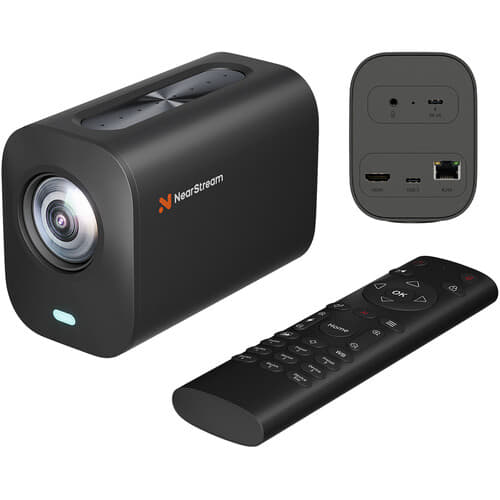
The NearStream VM20 is an all‑in‑one 4K streaming camera built for creators who want better image quality and control than a typical webcam, without the complexity of a full mirrorless or DSLR setup. It connects via USB, HDMI, or Ethernet, so you can drop it into almost any workflow—from Zoom calls and OBS scenes to direct RTSP streaming to platforms like YouTube or Facebook. Positioned around the sub‑$300 mark, it targets the sweet spot between budget webcams and pro cinema gear.
At first glance, the VM20 looks more like a compact PTZ‑style streaming camera than a traditional webcam. The body is designed to live on a tripod, a desktop stand, or even a ceiling mount, which immediately opens it up for studios, classrooms, and sanctuaries. A standard 1/4‑inch mounting thread means it plays nicely with the tripods and arms you already own. The included remote is central to the experience, giving you control over zoom, presets, and basic camera functions without ever touching the camera.
The main headline feature of the NearStream VM20 is its 4K resolution paired with a 40x hybrid zoom (10x optical plus digital). In practice, that means you can frame a wide establishing shot of a room and then punch into a tight close‑up without physically moving the camera. Because the first 10x of zoom is optical, you retain sharpness and detail for typical talking‑head or stage distances. This matters in real‑world use: you can cover a church pulpit, conference podium, or product table from the back of the room and still get usable, detailed shots.
Live streams rarely happen in perfect studio lighting, which is where the VM20’s sensor and processing become important. The camera is designed to handle typical indoor lighting—offices, classrooms, and small studios—without excessive noise or mushy shadows. Basic exposure and color adjustments let you fine‑tune the image to match your environment and other cameras. For many creators, this means fewer compromises when streaming at night, in a home office, or in venues where you cannot control every light.
One of the more underrated features of the NearStream VM20 is its audio system. Instead of assuming you will always bring a separate mic, the camera includes an 8‑microphone array designed to pick up 360‑degree audio in a small to medium room. Layered on top is AI‑based noise reduction that attempts to suppress environmental noise like HVAC hums or keyboard clicks. For serious production, you can still plug in an external mic via the 3.5 mm input, but for many scenarios—meetings, classrooms, quick streams—the built‑in audio is enough to get you on air fast.
Connectivity is where this camera really differentiates itself from a typical USB webcam. The USB‑C port lets it behave like a plug‑and‑play camera with your PC or Mac, perfect for Zoom, Teams, Google Meet, or streaming through OBS, Streamlabs, or similar software. The HDMI output means you can feed a clean signal into a video switcher, capture card, or hardware encoder, which is ideal for churches, multi‑camera streams, and event setups. The RJ45 Ethernet port supports RTSP, allowing the VM20 to stream over the network or function as an IP‑style camera, which is valuable in more advanced setups or permanent installations.
The included remote is not just a convenience—it’s core to how the VM20 fits into live workflows. You can store multiple presets (such as wide room, podium close‑up, and audience reaction) and recall them with a single button press. During a live stream, this effectively gives you “virtual camera angles” without running a multi‑camera rig. For solo creators, that means more dynamic streams with minimal overhead. For churches, classrooms, and meeting spaces, it lets a volunteer or facilitator switch views without technical training.
Traditional multi‑camera streaming setups often involve at least one mirrorless or DSLR camera, a separate capture card, an external microphone, a mixer, and a mess of cables and power adapters. The NearStream VM20 aims to compress much of that into a single device. You still get 4K resolution, meaningful zoom, and flexible connectivity, but the setup time is shorter, cabling is simpler, and ongoing operation is easier—especially for non‑technical users.
The VM20 is not trying to replace high‑end cinema cameras or full broadcast rigs. Instead, it targets creators and organizations who value ease‑of‑use, reliability, and versatility over maximum sensor size or lens interchangeability. If you are currently relying on a basic webcam or struggling with an overcomplicated mirrorless setup for live streaming, this camera sits in a very practical middle ground. It gives you a clear upgrade path in image quality and control without burying you under technical overhead.